



If you’re checking out the results of the MIAA Division 2 State Championships, don’t be misled by what the clock said at the finish line.
The numbers don’t tell the whole story — not when multiple Division 2A, 2B, and 2C teams were competing at Northfield Mountain, a course that can make even the most seasoned runner look like a wounded dog by the time they reach the finish. Case in point: The first kilometer is a steady uphill grind — no doubt made even tougher by the early rainfall before the meet’s start.
So while the times may have been slower than those from other divisions, the competition was fierce — and in a few cases, downright historic.
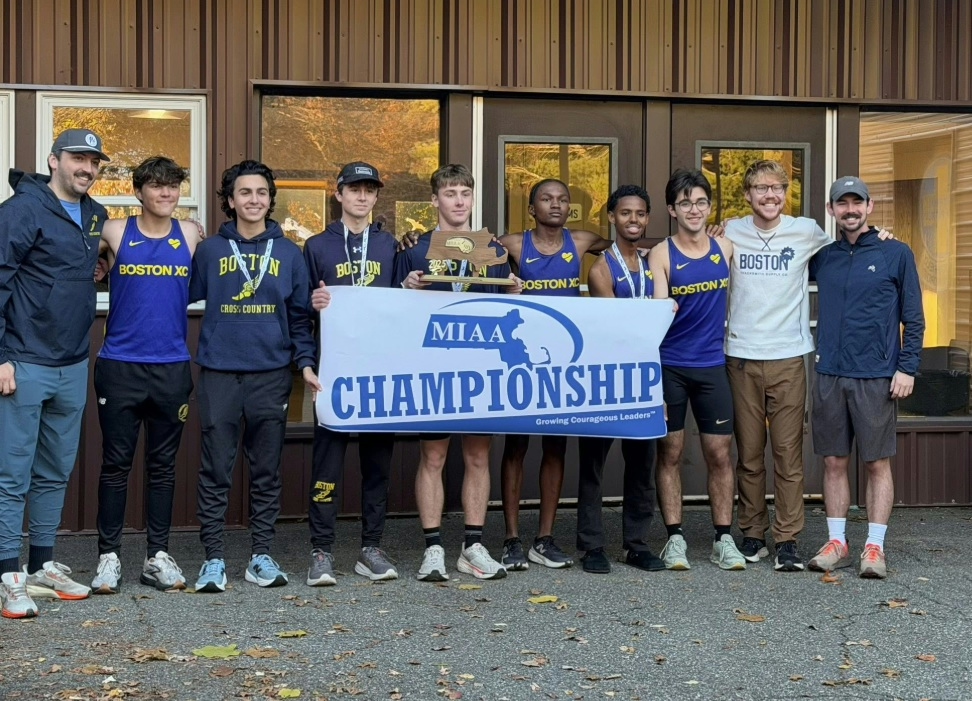
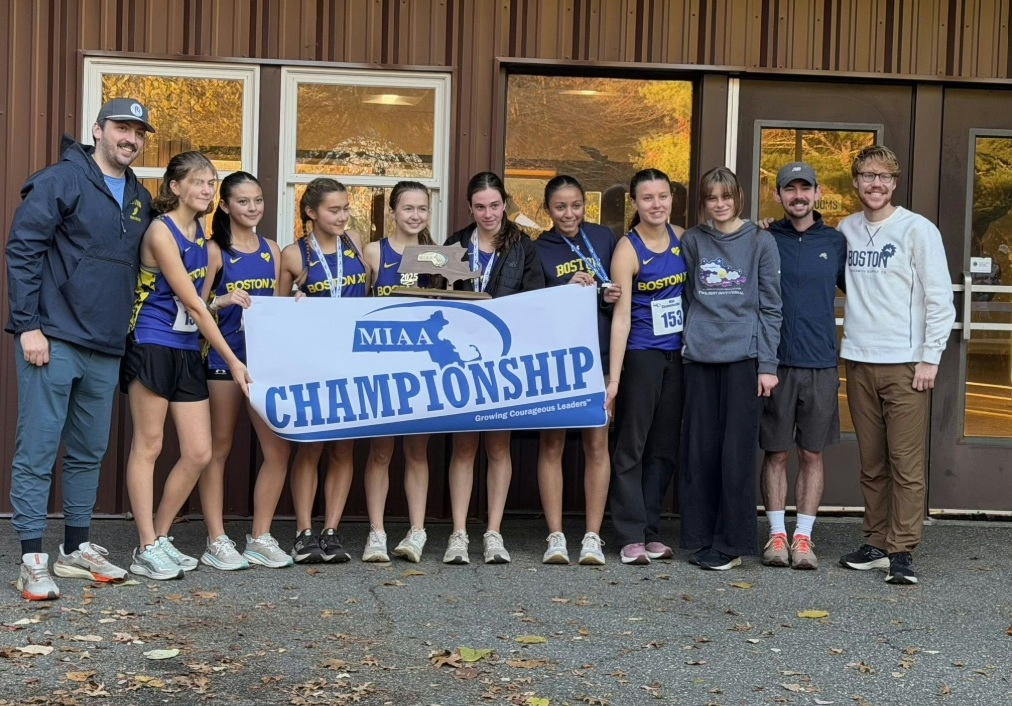
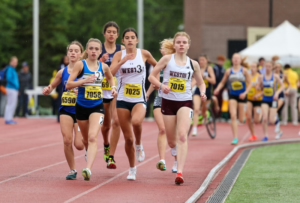
Historic, because of what the boys and girls of the Boston Public Schools co-op team accomplished. Drawing athletes from Latin Academy, O’Bryant, East Boston, Charlestown and others, BPS made history in the Division 2A meet by sweeping the competition in the final two races of the day.
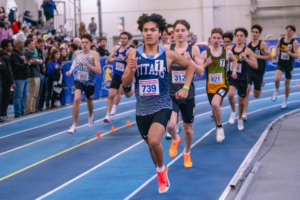
With all five of its scorers crossing the line before its closest rival’s fourth runner, BPS captured the boys’ race with a decisive 46–80 victory over second-place Walpole. Pack mentality wins races like these, and BPS certainly put on a clinic in that regard. Just 26 seconds separated their first through fifth finishers.
Junior Brandon Spiess led the quintet by placing third in 17:10.64. He was followed by juniors Adam Kramer (fifth, 17:12.70) and Khalid Jama (tenth, 17:22.42), senior Ryan Collins (11th, 17:24.41), and Nathaniel Hiff (18th, 17:36.88). Taking individual honors was Longmeadow’s Ethan Halpern, who clocked a solid 16:46.22 on the challenging 5K course.
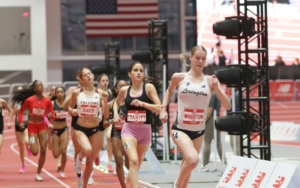
On the girls’ side, it was a much closer affair, with BPS tallying 74 points to earn the banner — 15 ahead of runner-up Marblehead. In the tightest race of the meet, junior Sara Blanco of BPS edged Canton’s Lauren Raffetto for the individual win. Blanco crossed the line in 19:38.16, just 0.77 seconds ahead of Raffetto. Rounding out the scoring for BPS were Anjuli Claire Szydlo (tenth, 20:30.17), Neve Flynn (12th, 20:40.00), Maya Friedmann (23rd, 21:39.50), and Maddy Lemay (32nd, 21:59.61).
Marblehead pulled off an upset to clip Westwood (third, 94 points). Based of 5K PRs, the Magicians were ranked sixth going into the meet. Marblehead was bolstered by two top 10 finishes by Sarah Munroe (seventh 20:18) and Marrietta O’Connell (eighth, 20:22). Perhaps the Magicians favored the hilly terrain of Northfield Mountain? Keep an eye on them next week at Fort Devens.
Twin Power Leads Whitinsville Christian To Girls’ Div. 2C Victory
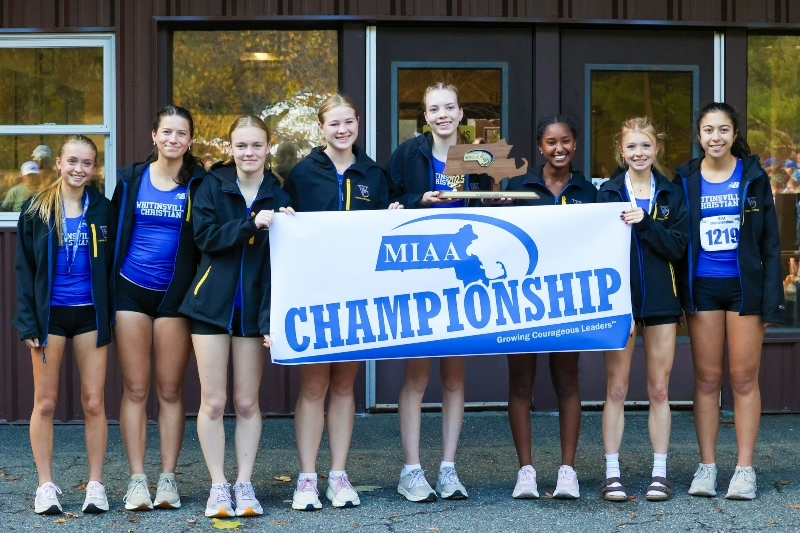
Two runners at the meet dipped under 19 minutes at Northfield Mountain — both from the same team, and both from the same household. As predicted, twin sisters Emily and Abby Flagg of Whitinsville Christian finished 1–2 in the Div. 2C girls’ race. Emily captured her third straight crown with a time of 18:30.73, while Abby secured second in 18:54.43. The Crusaders’ duo were more than a minute ahead of the next closest competitor.
Whitinsville Christian captured the team title, defeating Bishop Fenwick, 74-91. The Crusaders’ Inez Smith also cracked the top 10, placing ninth overall in 20:57.90.
Parker Captures Div. 2C Boys’ Crown, Weston Takes Top Team Honors
Talk about a breakthrough season. Last year as a sophomore, Oakmont’s Chayse Parker placed 29th in the Div. 3A race. On Saturday, Parker broke the tape as the Div. 2C champion, clocking a strong 16:59.4. He had to hold off a hard-charging pack, with Whitinsville Christian’s Benjamin Barron (second, 17:01.21) and Dedham’s Townsend Roussin (third, 17:01.35) finishing just steps behind.
Matt Fitzgibbon led Weston to the team title, placing fourth overall in 17:22.10. With just a 59-second gap between its first and fifth runners, the Wildcats edged Dedham for the championship, 88–101.

Back-To-Back For Gartner In Boys’ Div 2B, Groton-Dunstable Dominates Team Race
Silas Gartner gave evidence that a defense of last year’s Meet of Champions title could be a formality this weekend. Gartner claimed his second straight Division 2B crown with an impressive 16:11.63 at Northfield — the fastest time of the day — finishing roughly 100 meters ahead of runner-up Andrew Kosiba of Groton-Dunstable (16:28.93).
Kosiba helped lead the Crusaders to a dominant team victory. With all five scoring runners across the line before any other team’s third, Groton-Dunstable cruised to a 59–138 win over Amherst-Pelham. Greyson Duane added a seventh-place finish for the champions in 17:05.13.
Downin Prevails In Girls’ Div. 2B, Amherst-Pelham Claims Tight Team Battle
Tri Valley League champion Lucy Downin broke the tape in the Div. 2B girls’ race. The Holliston freshman was timed in 19:19.3. Northampton’s Malread O’Neal finished second at 19:24.61.
With just a 1:03 spread between its scoring runners, Amherst Pelham captured the team title with a 79-86 decision over Northampton. Junior Ella Austin led the charge for A-P, taking 11th overall with a time of 21:26.0. Right on her heels were teammates Genevieve Dole (12th, 21:27.36) and Lilly Pope (14th, 21:33.93).



8 Responses
What is the justification for a BPS co-op team? I don’t know much on this topic, admittedly, but putting the top talent from multiple high schools on the same team seems to create clear unfair advantage and likely violates the rules of the “Division 2” concept (although I may be wrong about that). Worth a story? There are tiny high schools (e.g. 400-700 students) with very small total rosters in this race. How many students are in the combined BPS schools involved with this team? 4000? 5000? How does that compare with Walpole? BPS pays teachers far more than the suburbs do. It’s not a budget issue. It’s not a privilege issue, as BLA and the O’Bryant are two of Boston’s “exam schools” and those are better resourced than many of the other single non co-op schools competing. Thanks and good luck to all of the runners.
That’s a fair question, that I don’t have the answer too. My guess as towards the justification would be the individual schools didn’t have their own programs, so the co-op team provides the kids the opportunity to compete if their school didn’t have an xc team. As far as why D2? I’m not sure. Your point about combined school size makes sense to me.
Hi, there are a lot of misconceptions in this comment. First off, there are only 33 runners on the team. 4 of the top boys’ and 5 of the top girls go to BLA, so the program is a majority of BLA. The other teams that participate in the program are from schools that cannot field their own teams (this is very common). Second off, BPS is one of the most underfunded programs in the state when it comes to athletics, so I would consider this still to be a “privilege issue.” BLA and Obryant are still public schools, with students from many different economic backgrounds (mostly lower than the average suburban kid). The salaries of BPS teachers have nothing to do with athletic funding. All of the runners have worked incredibly hard and should not be discredited for joining the only team they could.
BPS is far better funded than many of the public schools in this competition and yes, teacher salaries are related to the funding of coaches, who need to earn a living and are often also teachers. The clear and obvious point is that, by the MIAA formula, the BPS “Co-Op” team draws from 5,000+ students and should be a Division 1 team, probably D1A, and should be competing with D1 schools. It is a sizeable competitive imbalance. On the boys side, using your data, it takes 5 runners to score in XC and 7 runners factor in displacing other teams, so the BPS team benefits hugely from its exceptional #5 runner who comes from another high school. A quick scan of the divisional results across D2 reveals a Boys team that had an exceptional Top 4 and a huge dropoff to #5. Googling that school reveals a student population of 700. That team only started 6 runners.
The runners, of course, did nothing wrong. It’s the MIAA and BPS who have this team in the wrong division. There is plenty of socio-economic diversity and hardship among this population of schools. That said, schools with populations between 400 and 1500 should not be competing against this BPS Co-Op team.
The “exceptional fifth runner” attends BLA, and I’m not sure which team you are referring to that has an “exceptional top 4, and huge drop off to number 5.” None of the teams that fielded only 6 runners really fit that description, and the only boys team in 2A that only fielded 6 runners, got 18th, and would not have benefited from BPS being in a higher division. You may be referring to a team in 2B or 2C, but they would not be affected by BPS moving to D1A. It’s very interesting that no one seemed to care about the size of BPS when they were barely qualifying for All States, and the success highlighted in this article is very, very new. Additionally, your comment about how BPS is better funded than many of the public schools is false, considering that they draw from much higher taxes, and the funding that they receive is spread out to the 119 different schools that are included in the Boston Public Schools system. BPS has a much lower athletics participation rate than suburban schools, so the cross country team is not the only co-op team that the district must resort to. Possibly in the future, more students will join cross country in BPS, and the teams will split, if there are enough for each school to have their own team, but right now, the team is suited for their division, and it is fair for suburban students to compete against them.
The O’Bryant website says that the girls’ individual champion is from the O’Bryant, not BLA. Boys’ #3 and #5 are from the O’Bryant, not BLA. Not sure about other schools involved. This has aspects of a “superteam,” which is the downside of Co-Op teams.
Many teams have much smaller rosters than 33. Much, much smaller.
MIAA guidelines for Co-Op teams are easy to find and surprisingly detailed. Links below:
https://share.google/DmrWCp7DcyvsDGzLL
https://share.google/eyZGvUTymIN9idbBg
If BLA can roster 10 runners alone then Co-op not justified by these guidelines. The O’Bryant has an active middle school running program and is situated near the Reggie Lewis indoor track. BPS–Why no high school xc team?
My original point. The combined team is a superteam and draws from 4000-5000 students (and apparently middle-school running teams) and belongs in D1. Feeling stronger about that after researching.
The top 2 boys runners from the BPS Co-Op Team are O’Bryant students, not BLA students, according to the school website.
The O’Bryant has an active middle-school running program that has done very well in competition.
I want to thank you for this post. 6 years ago when my kid joined this team it had 8 boys and 1 girl. They dreamed of placing in a meet or even someday qualifying for States. At that moment, when they weren’t winning anything, we said, “watch, the second this team has a good season, people will suddenly say it’s not fair that the coop exists.” So you proved me right. Appreciate it.
No one has anything to say about private schools that can recruit, or the fact that these kids all get out of school at different times and have to take the T an hour to practice. If you think this team is such a shortcut to success, please, move to Boston and enroll at any high school. Your kid can be on a state champion (if he or she is fast enough; BPS is returning a lot of underclassmen). Until then, please spare everyone these sour grapes complaints.