


It all started with a simple question: “Do you have any bibs?”
Five words Mike Miller posed to a friend with the Doug Flutie Jr. Foundation for Autism six months ago. Five words that echoed something his late friend had said more than a decade earlier.
What persuades someone to run the Boston Marathon? To commit to the grueling 26.2-mile distance—one that can be unforgiving no matter how much you prepare.
For Miller, the longtime Weymouth High cross country and track & field coach, the answer traces back to his college days at Northeastern University. It was something his roommate started in 2013 and finished in 2014 – a journey that left a lasting impression.
But the motivation didn’t stop there.
It was also shaped by the countless athletes he’s coached over the last 20-plus years, along with the support of family and friends. And somewhere along the way, something else happened.
“I got to a point during my training where I was enjoying running more than I ever had before,” he said.
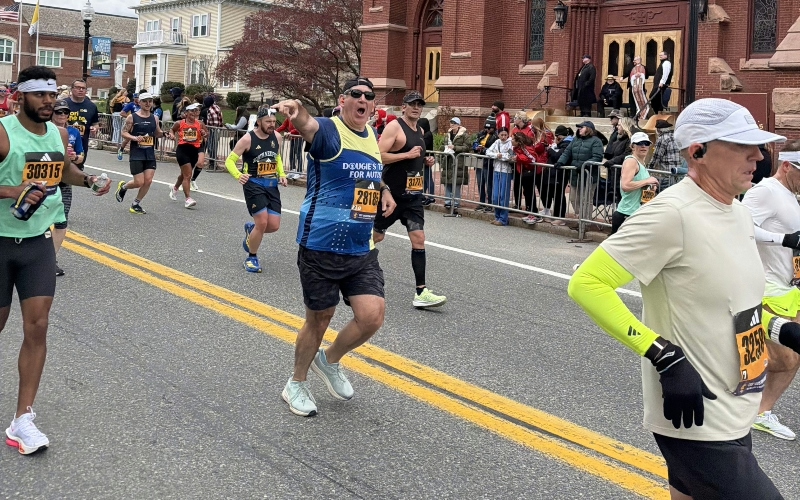
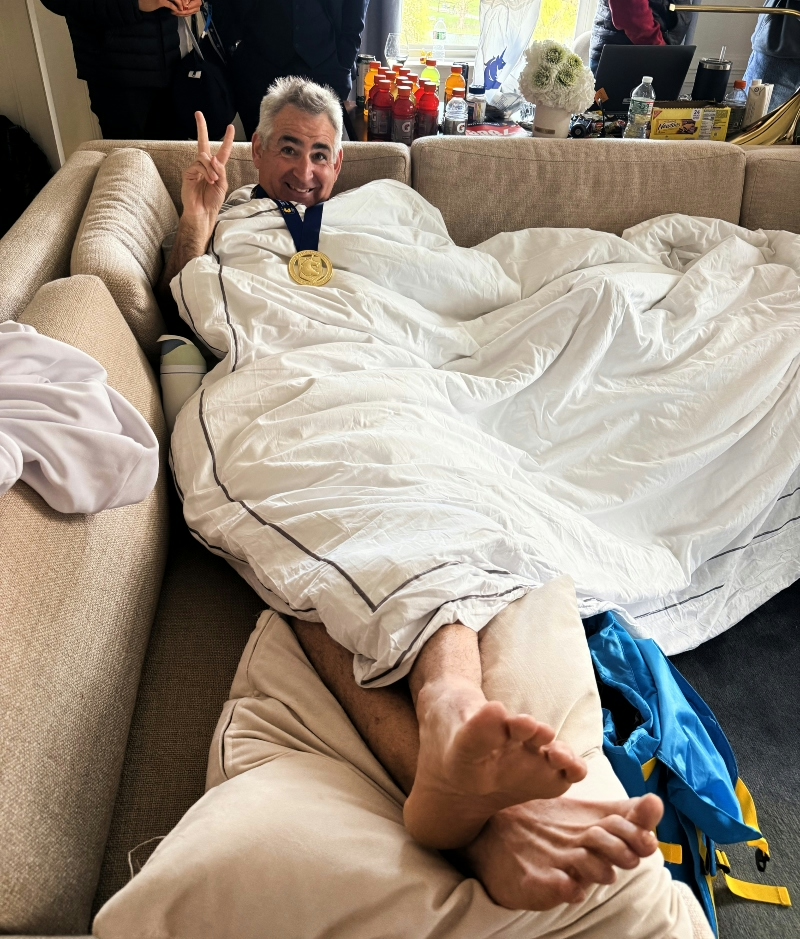
On Patriots’ Day this past Monday, Miller was among the 30,000 runners in the Boston Marathon, finishing the storied race in 4:14.45—just outside his original goal.
Miller’s journey began in early fall, well before the idea of a marathon had entered the picture. At first, he was simply running to stay in shape. But unlike in the past, he began focusing on the small details that would make his training more consistent.
“I have been hurt a lot. I didn’t really take care of myself as far as stretching and post-run stuff. It was always kind of playing catch-up – I’d get hurt, then rehab,” he said. “This fall, I started to take it more seriously. I focused on the little things I wasn’t doing before, like warming up properly. It got to November, and I really started to feel good.
It was at that point that Miller made a promise to himself.
“I told myself if I could get through a half (marathon), I’d look into running a marathon,” he said. “I ended up running 14 miles the day before Thanksgiving.”
The next day, Miller was on the phone with his good friend and former Notre Dame Academy coach, Terri Ladka, Senior Director of Development and Operations for the Doug Flutie Jr. Foundation for Autism. He reached out about securing a charity bib for the Boston Marathon.
“She told me she wasn’t sure and would put me on a waiting list,” he said. “A couple of days later, she called back with great news: ‘We have a bib.’”
There’s a deeper reason Miller chose the Doug Flutie Jr. Foundation for Autism. It’s not just the organization’s mission – it’s personal. It’s the same charity his college roommate, Dennis Doherty, ran for more than a decade ago.
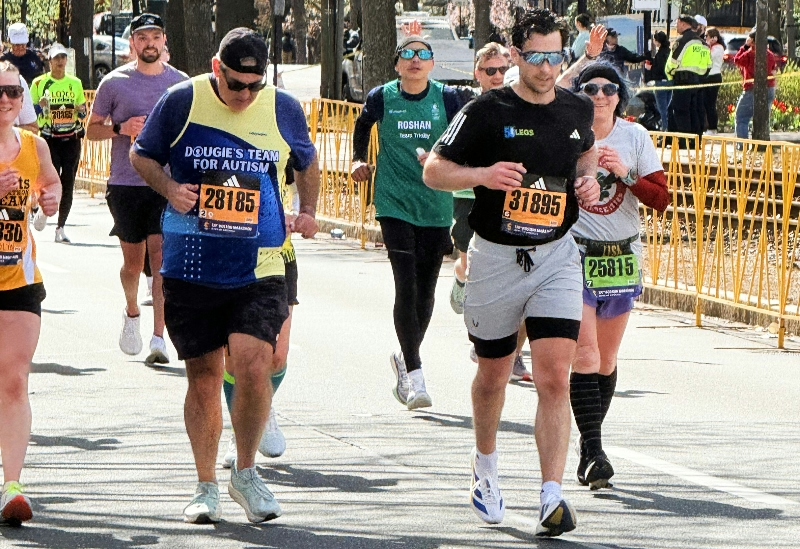
Miller credits Doherty, who passed away from pancreatic cancer three years ago, as the inspiration behind his own Boston journey. In 2013, Doherty ran the Boston Marathon for his son, Patrick, who lives with autism. It was also the year of the Boston Marathon bombing.
Doherty never made it to the finish line—but he did the following year.
“It was hard for him. He was going to run 4:30, 4:45 in 2013 and wasn’t able to finish after all the work he put into it. He got through 25 miles of that race and didn’t finish,” Miller said. “Most people would give up. You’ve already raised the money. Everybody knows you would have finished. You don’t have to do it again. He didn’t have the time to train the next year, but he still ran it. He just gutted it out and made sure he finished. That’s the type of guy he was.”
Miller set a fundraising goal of $10,000, quickly getting a sense of the support behind his marathon effort. He reached—and surpassed—the mark in just a few weeks, ultimately raising nearly $12,000 for the Doug Flutie Jr. Foundation for Autism.
“I reached it quickly,” he said. “It was easy. My friends and family supported me—the families of my athletes, current athletes, past athletes. They just came out of the woodwork for me. I felt a lot of pride.
“I’ve coached several of my former athletes to run marathons, and I felt like they were kind of paying me back in a sense. The support I got – not only financially, but just the number of people reaching out to ask how training was going and offer advice from their own experiences – it was just a really, really cool experience.”
Based on his training where he averaged 30-40 miles per week, Miller felt a realistic goal was a time around 4:10. With the mostly downhill first half of the race, the Weymouth coach was warned by several of his supporters to hold back in the early stages of the race and refrain from going out too fast before tackling the Newton Hills between miles 16 and 21.
Did he listen?
Not at all.
“I went out so fast,” he said. ”I went through the half (marathon) in 1:58 and I was still running at a little over nine-minute pace. Once I got to the hills, it took its toll.”
Throughout the race, Miller had several supporters among the thousands of spectators that lined the streets from the starting line in Hopkinton to finish at Copley Square. Good friend and Pembroke coach Greg Zopatti was one of them.
Zopatti, who rode his bike alongside Miller on some of his longer training runs, was at several checkpoints.
“He was everywhere,” he said. “I don’t know how he did it. It was like he was teleported. He was at four, eight, 12 and 20 miles.”
Along the route, occasionally one of his current or former athletes at the race would provide some emotional support.
“They were all over the course,” he said. “I think they really felt strongly about giving back with hopefully something that I gave them.”
Miller went through the 5K mark in Ashland in 28:22 and reached the 10K in Framingham in 56:49. He maintained a steady sub-10-minute pace through the first 30 kilometers.
But it was the Newton Hills where the real challenge began. After cresting the first of the four hills in the five-mile stretch, Miller began to feel it in his legs.
“The first hill at mile 16, I got up it and figured it wasn’t so bad,” he said. “The next two hills are kind of up and down. On the downhills, the deadness in my legs was something I had never felt before.”
“I did lower-body lifts,” he added. “I lifted twice a week for the last five months because I really wanted to survive the hills. For a long time, I was a hill walker – I’d hit a hill and walk. I couldn’t get up a hill. It was a mental block for me. I found the lifting really made a difference, whether it allowed me to drive my quads more.”
Like most who have run the race, Miller credited the Boston crowd as a major factor in getting him to the finish line, particularly over the final five miles when the body is telling you to stop but the mind is still fighting.
“It’s incredible,” he said. “There are people who just come out and hold signs—they don’t even know anyone running. They just want to help strangers. There’s something really powerful about that, the selfless act of people coming out just to push runners through.”
As he approached the Chestnut Hill area and Boston College, Miller got a surprise from a fellow coach and his athletes.
“Newton North coach Dave Tesler had the whole team out there chanting my name,” he said. “It’s stuff like that you really appreciate. A couple of times in the last few miles, I was walking a few steps, and that’s when one of my old runners would come out of the woodwork and say, ‘Hey, let’s go, You’ve got to get there.’ There is magic in Boston.”
From Beacon Street and Cleveland Circle to the finish down Boylston Street, the crowd and noise only continued to build.
“There was like a wave that just got thicker and louder,” he said. “Every tenth of a mile, there were more and more people. The Red Sox game was getting out, so you had all these fans on the streets. BC was incredible. Wellesley College was incredible.
“Framingham is the one place nobody really talks about, but there are people out on their lawns, Brazilian families playing salsa music. It’s just nonstop. There’s nothing like it. There’s nothing that can compare. It’s very unique.”
At Kenmore Square with about two miles remaining, he spotted his brother and his friends.
“I was ready to be done. They got me through the rest of it with their enthusiasm and support,” he said. “I kind of ran over and dove into the crowd where they were. I came out from that and I was like, ‘It’s time to go.’”
The last couple of miles, Miller also drew some inspiration from above. Remembering his late friend, as he made his final push home.
“I was talking to him the last two miles. I was yelling at him a couple of points – ‘Why did you get me into this?’” he quipped. “His brother was out on the course for me. His wife reached out to me all the time during my training. There was never a moment I could give up because he didn’t.”
There were a few people waiting for him as he rounded the final corner on Boylston Street to the finish. The first was longtime MA track & field official Tommy Meagher, who has been the head finish line official at Boston since 1997.
“When I crossed the line, I gave him a big bear hug,” he said. “He was waiting for it. He was a sight for sore eyes. I could see him the whole way. I knew he was reeling me in. I knew he was there. You make that turn on Boylston Street and you see the finish line. It’s a quarter of a mile away. It’s the longest quarter mile on the course.”
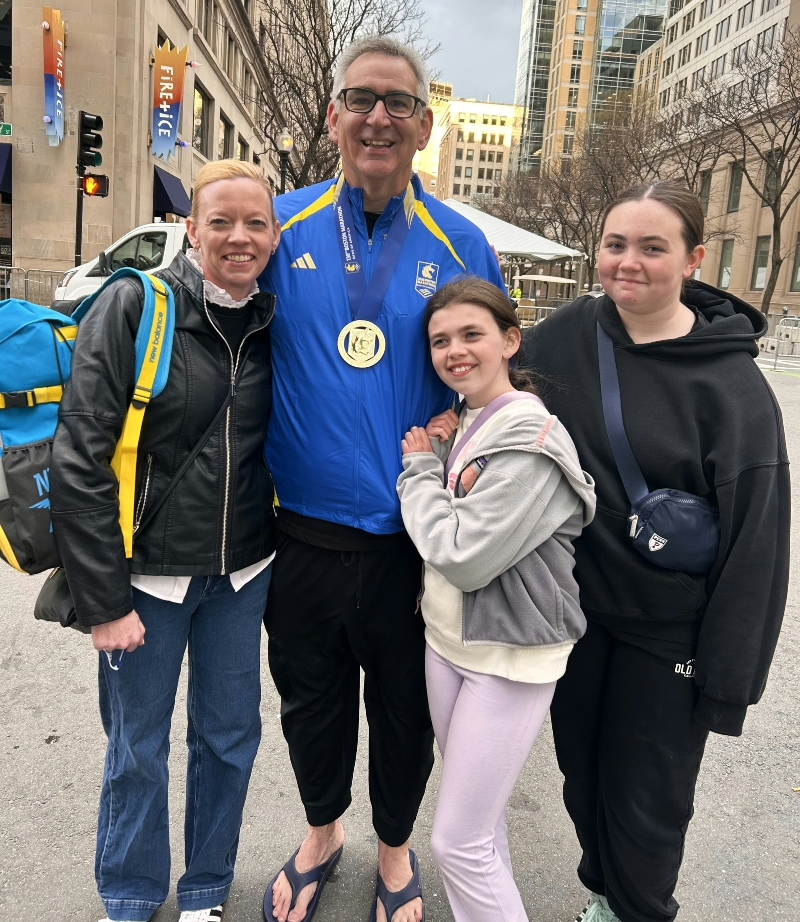
Finally, there was his wife Kate and two young children, 13-year-old Scarlett and nine-year-old Poppy.
“It was euphoria,” he said. “There were moments in the last hour, I didn’t know if I was going to make it to the finish. I mean it. I’m not exaggerating. Deep down, I always knew I was going to get to the finish line. Knowing I was going to get across the finish, it meant a lot. After I finished, I had to walk all the way down Boylston basically to the Common. It took me 20 minutes to walk that route. I couldn’t wipe the smile off my face”